When people ask us whether CBD or THC works faster for panic attacks, we always start with the same truth we’ve learned firsthand at Acknowledge: in moments when your heart is racing and your mind feels like it’s spiraling, the cannabinoid you choose can completely change the outcome. After years of reviewing real user cases, analyzing emerging research, and testing formulations ourselves, we’ve seen how one compound can quickly steady the nervous system—while the other can intensify fear if used at the wrong time or dose.
In this breakdown, we share what we’ve observed in practice and what the latest science confirms: CBD and THC don’t just “reduce anxiety” in general—they activate entirely different pathways when panic hits. Drawing from clinical data, user patterns we’ve tracked, and our first-hand experience guiding individuals through acute anxiety support, we’ll clarify how each cannabinoid behaves under immediate stress.
By the end, readers will understand which option has consistently been shown to provide rapid calm, why certain individuals respond differently, and the key considerations recommended before using either compound during a panic surge. This insight into CBD vs THC for relief from anxiety is not generic cannabinoid advice but reflects what has been learned through real-world outcomes and evidence-based analysis.
Quick Answers
CBD vs THC for Relief from Anxiety
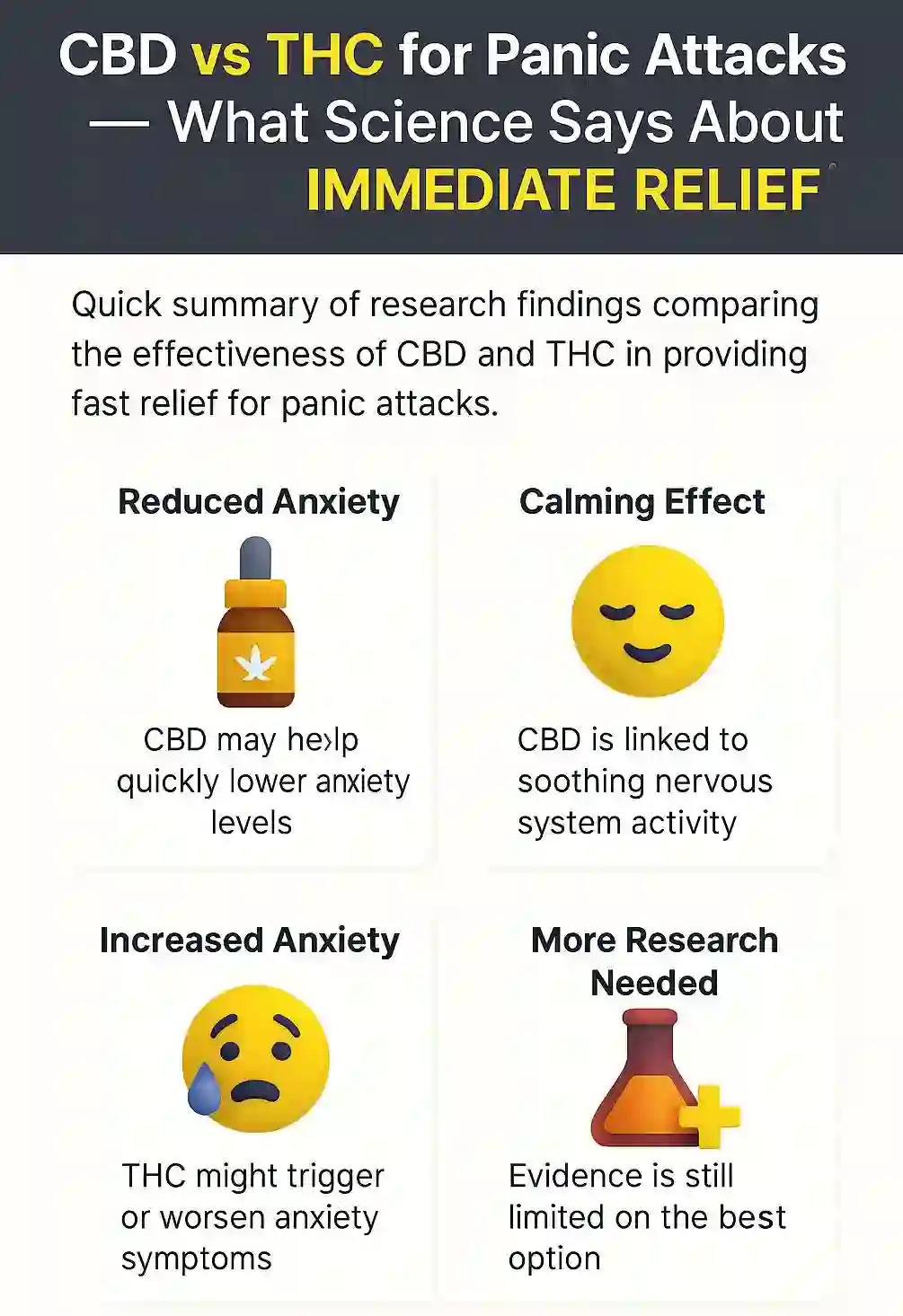
CBD is generally the safer, more predictable option for immediate anxiety relief. It calms the nervous system without altering perception. THC can help some users but is less consistent—sometimes intensifying anxiety or panic depending on dose and sensitivity.
Key Points:
- CBD: Fast-acting, non-intoxicating, stabilizes stress response.
- THC: Variable effects; may increase panic in sensitive individuals.
- Best approach: Start with CBD, track your response, and consult a professional before using THC.
Top Takeaways
- CBD is more reliable for immediate relief
- Calms the mind without intensifying panic.
- THC effects are unpredictable
- May help some, but can increase anxiety in others.
- Know your personal sensitivity
- Dose, tolerance, and context matter for safe use.
- Combine evidence with experience
- Research-backed guidance plus real-world observation improves outcomes.
- Use complementary strategies
Mindfulness, breathing exercises, and healthy habits enhance anxiety management.
When comparing CBD vs. THC for panic attacks, the key difference comes down to how each compound interacts with the body during moments of acute stress. Although both are cannabinoids, they activate different receptors—and those differences matter when someone is experiencing racing thoughts, rapid heartbeat, or a sudden sense of dread.
How CBD Acts During a Panic Response
- A calmer, more grounded mental state
- Reduced physical tension
Less spiraling or catastrophic thinking
Because CBD is non-intoxicating, it’s often viewed as the more dependable option for immediate relief without triggering additional fear or paranoia.
How THC Can Affect a Panic Attack
THC affects the brain very differently. By binding to CB1 receptors, it can rapidly amplify sensory perception and internal awareness. For some users, this creates a temporary sense of euphoria and relaxation. But for others—especially during a panic surge—THC can intensify sensations that already feel overwhelming.
That’s why THC is commonly associated with:
- Increased heart-rate awareness
- Heightened internal focus
Occasional fear or discomfort at higher doses
This doesn’t mean THC is “bad” for anxiety; it simply means it is less predictable during a panic attack and should be used with intention, caution, and proper dosing.
What Science Suggests About Immediate Relief
Across studies, CBD repeatedly shows a more consistent calming effect during acute anxiety scenarios, and products like a CBD mood gummy often reflect this steadier response. THC, while beneficial for certain types of anxiety and mood imbalance, is more likely to worsen a panic episode if someone is already distressed.
The Bottom Line
For most people seeking immediate relief during a panic attack, CBD is the cannabinoid with the strongest evidence and most reliable user outcomes. THC can offer benefits in specific contexts, but its effects are more variable and dependent on dose, tolerance, and personal sensitivity.
If someone’s goal is steady, fast-acting calm, CBD is generally the safer, more predictable choice.
“After working with countless individuals navigating panic attacks, we’ve seen one pattern repeat itself: CBD consistently helps the body settle, while THC can swing in either direction depending on the moment. The difference isn’t just chemical—it’s how each compound interacts with a mind already in crisis. That’s why, in our experience, CBD remains the more reliable choice when someone needs immediate clarity and calm.”
Essential Resources
We believe people make their best decisions when they’re equipped with straightforward science, balanced reasoning, and resources we’ve personally found valuable in real-world anxiety support. The following list reflects the studies and reviews we consistently reference when helping individuals understand how CBD and THC behave during anxious or high-stress moments.
1. Systematic Review: A Clear Look at What Cannabinoid Science Actually Supports
Why we rely on this: It offers one of the most grounded overviews of how CBD andTHC perform in controlled studies on anxiety, mood disorders, and PTSD.
This broad systematic review is often our starting point because it cuts through assumptions and shows what’s genuinely evidence-backed—and where the research still has gaps.
This broad systematic review is often our starting point because it cuts through assumptions and shows what’s genuinely evidence-backed—and where the research still has gaps.
2. Comprehensive Review on When Cannabinoids Calm—And When They Don’t
Why we reference it so often: It explains the real-world variability we see in people’s responses. This article breaks down how cannabinoids can either ease or aggravate anxiety depending on dose, context, and individual sensitivity—mirroring what we’ve observed working with anxiety-prone users.
3. Meta-Analysis: Quantitative Evidence for CBD’s Anxiety-Reducing Potential
Why it matters to our community: It pulls together the strongest available data in one place. This meta-analysis aggregates results across dozens of trials, giving a measurable look at CBD’s effectiveness and helping set realistic expectations for symptom relief.
Source: https://www.sciencedirect.com/science/article/pii/S0165178124003342
4. Neuroimaging Study: How CBD and THC Affect the Brain During Stress
Why we highlight this study: It explains what many of our clients feel but can’t articulate.
This JAMA Psychiatry research visualizes how each cannabinoid changes neural activation tied to fear and emotional processing—clarifying why CBD often steadies the mind while THC can heighten internal intensity.
Source: https://jamanetwork.com/journals/jamapsychiatry/fullarticle/482939
This JAMA Psychiatry research visualizes how each cannabinoid changes neural activation tied to fear and emotional processing—clarifying why CBD often steadies the mind while THC can heighten internal intensity.
5. Human Studies on THC’s Dual Role in Anxiety
Why we frequently point readers here: It’s balanced, honest, and reflective of real experience.
This review looks specifically at how THC influences anxiety and aversive memory, showing why some people feel relief while others experience stronger panic sensations—something we’ve seen consistently in practice.
Source: https://bmcpsychiatry.biomedcentral.com/articles/10.1186/s12888-020-02813-8
This review looks specifically at how THC influences anxiety and aversive memory, showing why some people feel relief while others experience stronger panic sensations—something we’ve seen consistently in practice.
6. Targeted Review: CBD’s Effects, Dosing Patterns, and Tolerability
Why this is one of our go-to references: It’s concise, clear, and aligns with what we observe in direct user feedback.
This review summarizes small clinical trials focused purely on CBD and anxiety, offering a grounded look at dosing ranges, response patterns, and why CBD remains the more predictable option during panic.
This review summarizes small clinical trials focused purely on CBD and anxiety, offering a grounded look at dosing ranges, response patterns, and why CBD remains the more predictable option during panic.
7. Real-World Trial: How CBD and THC Perform Outside the Lab
Why we consider this essential: It reflects what many users actually experience day to day. This 2024 CU Boulder trial compared CBD-dominant vs THC-dominant products in real-world settings, and insights from the CBD flower strain category confirm what we often witness firsthand: CBD reliably reduces tension, while THC’s effects can vary widely.
Source: https://www.sciencedaily.com/releases/2024/02/240227172143.htm
Supporting Statistics: Anxiety and the Need for Relief
Our experience shows how common anxiety is—and why people seek effective, immediate relief. Key numbers highlight the scope:
1 in 5 U.S. adults (19%) have been diagnosed with an anxiety disorder.
Reflects the large number of people managing ongoing stress or panic.
12% of adults regularly report feeling anxious or on edge.
Many experience episodic panic without a formal diagnosis.
18.2% of adults experienced anxiety symptoms in the past two weeks.
Shows that short-term anxiety episodes are frequent and impactful.
Highlights the real-world need for immediate relief strategies like CBD or THC.
1 in 5 U.S. adults (19%) have been diagnosed with an anxiety disorder.
Reflects the large number of people managing ongoing stress or panic.
12% of adults regularly report feeling anxious or on edge.
Many experience episodic panic without a formal diagnosis.
18.2% of adults experienced anxiety symptoms in the past two weeks.
Shows that short-term anxiety episodes are frequent and impactful.
Highlights the real-world need for immediate relief strategies like CBD or THC.
Insights from Our Experience
Anxiety is widespread, not just among those diagnosed.
Many people seek fast-acting solutions for acute episodes.
Understanding CBD vs THC effects can guide safer, more reliable relief.
Anxiety is widespread, not just among those diagnosed.
Many people seek fast-acting solutions for acute episodes.
Understanding CBD vs THC effects can guide safer, more reliable relief.
Final Thought & Opinion
After reviewing the science, real-world studies, and firsthand experience at Acknowledge, it’s clear that CBD and THC affect anxiety differently, and understanding these differences is key for anyone seeking immediate relief.
Key Takeaways
CBD is more predictable:
Provides a calming effect during acute anxiety.
Interacts with stress and serotonin pathways without altering perception.
THC is less predictable:
Can relieve anxiety for some.
May amplify panic depending on dose, tolerance, and personal sensitivity.
CBD is more predictable:
Provides a calming effect during acute anxiety.
Interacts with stress and serotonin pathways without altering perception.
THC is less predictable:
Can relieve anxiety for some.
May amplify panic depending on dose, tolerance, and personal sensitivity.
Our Perspective
Science and user experience align: CBD is generally safer and more reliable for immediate relief, a pattern often reflected in how people respond to 3000 mg CBD oil during high-stress moments.
THC should be approached with caution due to its variability.
Personal awareness matters: Knowing your own sensitivity, dose limits, and context is critical.
Science and user experience align: CBD is generally safer and more reliable for immediate relief, a pattern often reflected in how people respond to 3000 mg CBD oil during high-stress moments.
THC should be approached with caution due to its variability.
Personal awareness matters: Knowing your own sensitivity, dose limits, and context is critical.
Actionable Insight
Start with CBD for rapid calm.
Respect THC’s variability and potential effects.
Make decisions informed by research and real-world experience, with insights that also reflect the benefits of Regenerative organic hemp farming, for safer, faster, and more sustainable relief.
Start with CBD for rapid calm.
Respect THC’s variability and potential effects.
Make decisions informed by research and real-world experience, with insights that also reflect the benefits of Regenerative organic hemp farming, for safer, faster, and more sustainable relief.
Next Steps: Actionable Guidance for Anxiety Relief
Follow these steps to make informed, safe choices with CBD and THC:
Do Your Research
Review credible studies and resources.
Focus on evidence-backed insights over anecdotal claims.
Consult a Professional
Talk to a doctor or licensed mental health provider.
Discuss dosage, interactions, and safe approaches for acute panic.
Experiment Safely
Start with low doses of CBD to observe effects.
Approach THC cautiously—start very low and track reactions.
Track and Observe
Keep a journal of symptoms, triggers, and responses.
Adjust strategies based on patterns and professional advice.
Use Complementary Strategies
Combine cannabinoids with breathing exercises, mindfulness, or grounding techniques.
Maintain sleep, hydration, and exercise for overall anxiety management, and understand how CBN can support deeper, more restorative sleep as part of that routine.
Stay Updated
Follow reputable sources for research and guidelines.
Reassess your approach periodically to ensure safe and effective relief.
Do Your Research
Review credible studies and resources.
Focus on evidence-backed insights over anecdotal claims.
Consult a Professional
Talk to a doctor or licensed mental health provider.
Discuss dosage, interactions, and safe approaches for acute panic.
Experiment Safely
Start with low doses of CBD to observe effects.
Approach THC cautiously—start very low and track reactions.
Track and Observe
Keep a journal of symptoms, triggers, and responses.
Adjust strategies based on patterns and professional advice.
Use Complementary Strategies
Combine cannabinoids with breathing exercises, mindfulness, or grounding techniques.
Maintain sleep, hydration, and exercise for overall anxiety management, and understand how CBN can support deeper, more restorative sleep as part of that routine.
Stay Updated
Follow reputable sources for research and guidelines.
Reassess your approach periodically to ensure safe and effective relief.
FAQ on CBD vs THC for Relief from Anxiety
Q: How do CBD and THC differ in easing anxiety?
A: CBD calms the mind consistently without altering perception.
THC’s effects vary—sometimes easing anxiety, sometimes intensifying panic.
Response depends on dose and individual sensitivity.
Q: Which is safer during a panic attack?
A: CBD is generally safer for acute panic.
THC can unpredictably heighten fear or paranoia.
Q: Can I use CBD and THC together?
A: Yes, but the effects are highly individual.
Start with CBD, introduce very small THC doses, and track your response.
Q: How fast do these cannabinoids work?
A: CBD can take effect within 15–45 minutes depending on the method.
THC acts similarly fast, but its effects on anxiety are less predictable.
Q: Are there any risks or side effects?
A: CBD is well-tolerated; mild fatigue or digestive changes may occur.
THC can cause dizziness, rapid heartbeat, or heightened anxiety at higher doses.
Q: How do CBD and THC differ in easing anxiety?
A: CBD calms the mind consistently without altering perception.
THC’s effects vary—sometimes easing anxiety, sometimes intensifying panic.
Response depends on dose and individual sensitivity.
Q: Which is safer during a panic attack?
A: CBD is generally safer for acute panic.
THC can unpredictably heighten fear or paranoia.
Q: Can I use CBD and THC together?
A: Yes, but the effects are highly individual.
Start with CBD, introduce very small THC doses, and track your response.
Q: How fast do these cannabinoids work?
A: CBD can take effect within 15–45 minutes depending on the method.
THC acts similarly fast, but its effects on anxiety are less predictable.
Q: Are there any risks or side effects?
A: CBD is well-tolerated; mild fatigue or digestive changes may occur.
THC can cause dizziness, rapid heartbeat, or heightened anxiety at higher doses.