
This guide explores easy, accessible brain training games that support memory improvement, explains why they work, how to play them daily, and how to avoid common pitfalls that limit progress. The focus is on games you can start immediately, using minimal time and effort, while still producing meaningful cognitive benefits.
Quick Answers
brain training exercises
Brain training exercises are simple, targeted mental activities that strengthen memory, focus, and cognitive flexibility. They work best when they involve active recall, problem-solving, and real-life application rather than passive repetition. Short, consistent practice delivers the most reliable results.
Top Takeaways
Brain training games work best when they resemble everyday memory challenges
Short, consistent play is more effective than long, infrequent sessions
Games that involve recall and patterns outperform reaction-only games
Research-backed approaches deliver better results than novelty games
Small daily habits lead to noticeable memory improvement over time
How Brain Training Games Strengthen Memory
Memory improves when the brain is repeatedly challenged to store, retrieve, and adapt information. Effective brain training games activate multiple cognitive pathways at once—attention, recall, sequencing, and flexibility—rather than relying on repetition alone.
Games that introduce mild difficulty, variation, and mental effort help reinforce neural connections related to memory formation. When play requires thinking just beyond comfort level, the brain adapts more efficiently.
The Most Effective Simple Brain Training Games for Memory
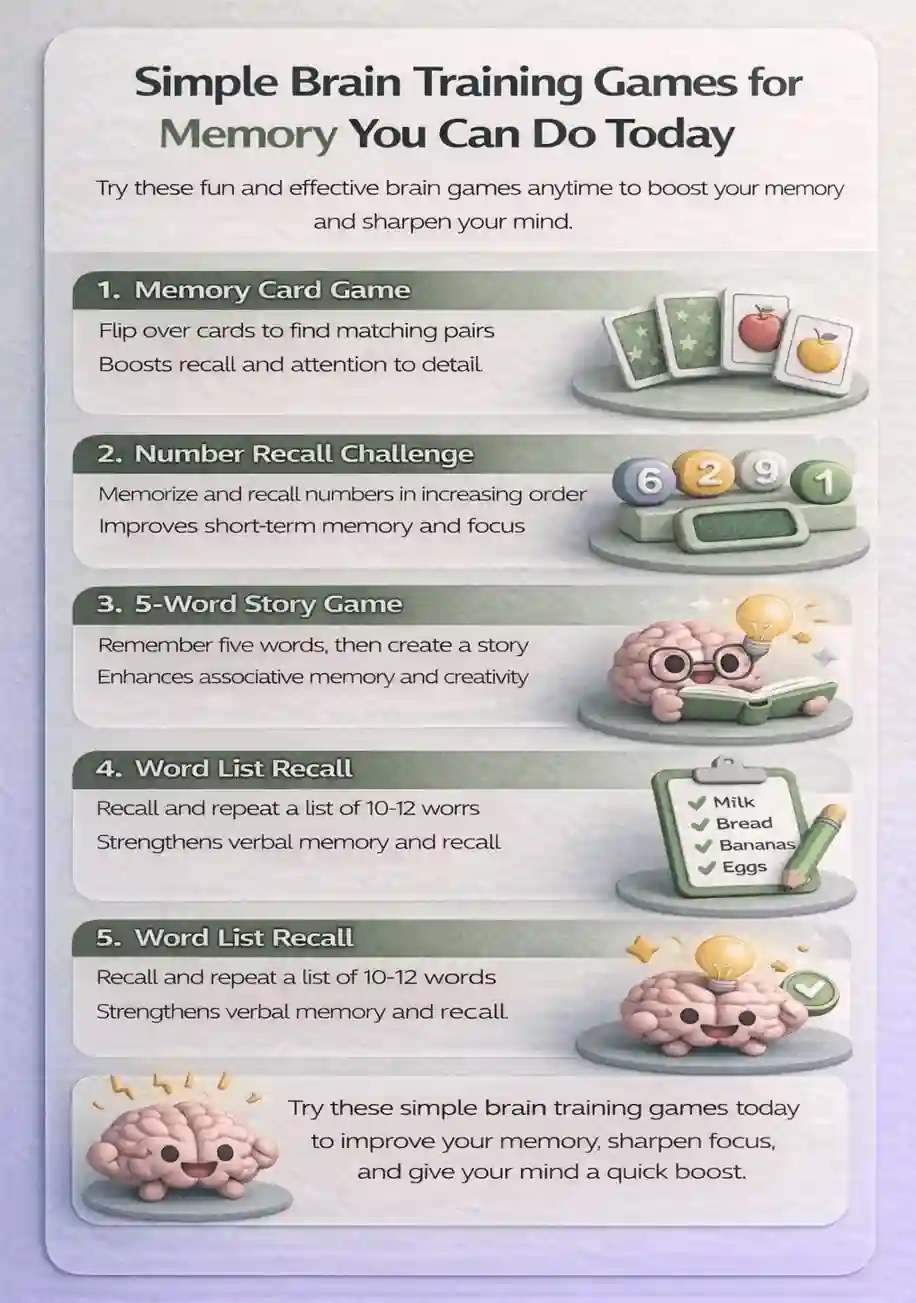
The most useful memory-focused brain training games fall into a few practical categories:
Recall games that require remembering words, numbers, or details
Pattern-matching games that challenge working memory
Sequencing games that strengthen order and timing recall
Mental visualization games that reinforce long-term memory storage
These games work because they reflect how memory is used in daily life—remembering conversations, instructions, and information—rather than artificial testing scenarios, while also reinforcing positive thinking by building confidence through practical, real-world success.
How Often to Play for Real Results
Consistency matters more than duration. Short sessions of 10–15 minutes per day are more effective than longer, irregular play. Rotating games slightly helps prevent mental autopilot and keeps memory systems actively engaged.
Regular play encourages steady improvement without mental fatigue.
Common Mistakes That Limit Memory Gains
Many people unintentionally limit progress by:
Playing the same game without increasing difficulty
Focusing only on speed instead of accuracy and recall
Treating games as entertainment rather than intentional training
The most effective brain training games challenge the brain just enough to require effort without becoming overwhelming.
Choosing the Right Brain Training Games for You
The best brain training games are ones you can play consistently and enjoy enough to stick with. Games that are simple, adaptable, and mentally engaging lead to more reliable improvement than complex systems that are difficult to maintain, which is why a 7 minute brain boost routine often fits more naturally into daily practice.
When games align with how memory naturally works, progress becomes measurable rather than theoretical.
“Real memory improvement comes from games that challenge thinking—not just reaction time. When play reflects real-life memory demands, progress becomes noticeable and sustainable.”
Essential Resources on Brain Training Exercises
Below is a brand-aligned, scannable resource list written in the InfiniteMind voice—clear, practical, and focused on real cognitive improvement.
Understand the Fundamentals of Brain Training
California Learning Resource Network — What Is Brain Training?
A straightforward primer explaining how brain training works, what it targets (memory, attention, processing speed), and why neuroplasticity matters.
https://www.clrn.org/what-is-brain-training/
Discover Proven Cognitive Strategy Techniques
Center for BrainHealth — Cognitive Strategy Training
Explores research-driven cognitive strategies that strengthen memory and thinking, supported by clinical evidence and real-world application.
https://centerforbrainhealth.org/science/cognitive-training
Get Practical, Everyday Brain Training Tools
Brain-Exercises.org — Brain Training Exercises & Tools
A hands-on collection of memory and focus exercises you can start using immediately to build consistent brain training habits at home.
https://brain-exercises.org/
Access Medically Reviewed Brain Exercise Advice
Healthline — Brain Exercises for Memory and Focus
Medically reviewed guidance on brain exercises, explaining how specific activities support memory, focus, and overall cognitive health.
https://www.healthline.com/health/mental-health/brain-exercises
Try Personalized, Science-Backed Training
BrainHQ — Adaptive Brain Training Platform
A neuroscience-based training system that adapts to your performance and targets memory, attention, and processing speed with measurable results.
https://www.brainhq.com/
Learn How Cognitive Training Programs Are Designed
Springer — Cognitive Training Programs Overview
An in-depth overview of how structured cognitive training programs are built, why they work, and where they are most effective.
https://link.springer.com/chapter/10.1007/978-3-031-88117-6_9
Explore Everyday Brain Training Games
Penn State Health — Brain Training Games & Activities
A practical list of simple brain games and activities shown to engage memory, creativity, and cognitive flexibility in daily life.
https://prowellness.childrens.pennstatehealth.org/22-brain-exercises-to-improve-memory-cognition-and-creativity/
These resources emphasize that effective brain training is grounded in science, consistency, and measurable outcomes, underscoring the importance of wellness screenings in identifying cognitive needs early and guiding the right brain training exercises to support long-term mental performance and overall brain health.
Supporting Statistics
Over 6 million Americans currently live with Alzheimer’s disease, highlighting how widespread memory decline already is across U.S. households, according to the National Institute on Aging Alzheimer’s disease fact sheet.
An estimated 7.2 million adults aged 65 and older are projected to have dementia by 2025, or roughly 1 in 9 seniors, based on data from the Alzheimer’s Association Facts and Figures report.
More than 200 clinical trials have examined cognitive and brain training methods, demonstrating that brain training is a heavily researched area—especially when it comes to memory, attention, and prevention, as reviewed by the National Institute on Aging’s cognitive intervention research.
Annual dementia-related care costs in the U.S. are projected to exceed $380 billion, underscoring the economic impact of cognitive decline and the growing emphasis on preventive brain health strategies, according to Alzheimer’s Association cost projections.
These statistics reinforce why practical, preventive brain training exercises continue to gain importance—not as a trend, but as a long-term cognitive health strategy backed by research and real-world need, particularly for programs designed to improve spatial recognition through focused, evidence-based training.
Final Thought & Opinion
Brain training games don’t need to be complicated to be effective. The strongest results come from simple games played consistently and with intention.
Patterns emerge clearly over time:
Games that mirror real thinking improve memory more reliably
Consistency matters more than variety
Mental effort beats novelty
When brain training games are treated as a long-term habit rather than a quick fix, improvements show up in daily life—clearer thinking, better recall, and stronger focus.
Next Steps
Define one memory goal (recall, focus, clarity)
Choose 2–3 simple brain training games
Play for 10–15 minutes, 4–5 days per week
Increase difficulty gradually
Apply memory skills to real-life situations
Track progress weekly
Stick with research-backed methods
Consistency turns simple games into lasting cognitive improvement, just as regular reading strengthens brain function through repeated, focused mental engagement over time.
FAQ on Brain Training Exercises
Q: Do brain training games actually improve memory?
A: Yes—when they involve recall, attention, and problem-solving rather than passive play.
Q: How often should brain training games be played?
A: Short sessions work best.
10–15 minutes
4–5 times per week
Q: Are apps required?
A: No. Many effective games can be done mentally or with simple materials.
Q: How soon do results appear?
A: Improvements are often noticeable within a few weeks of consistent play.
Q: Who benefits most from brain training games?
A: Anyone seeking better memory or focus—especially those who practice regularly.