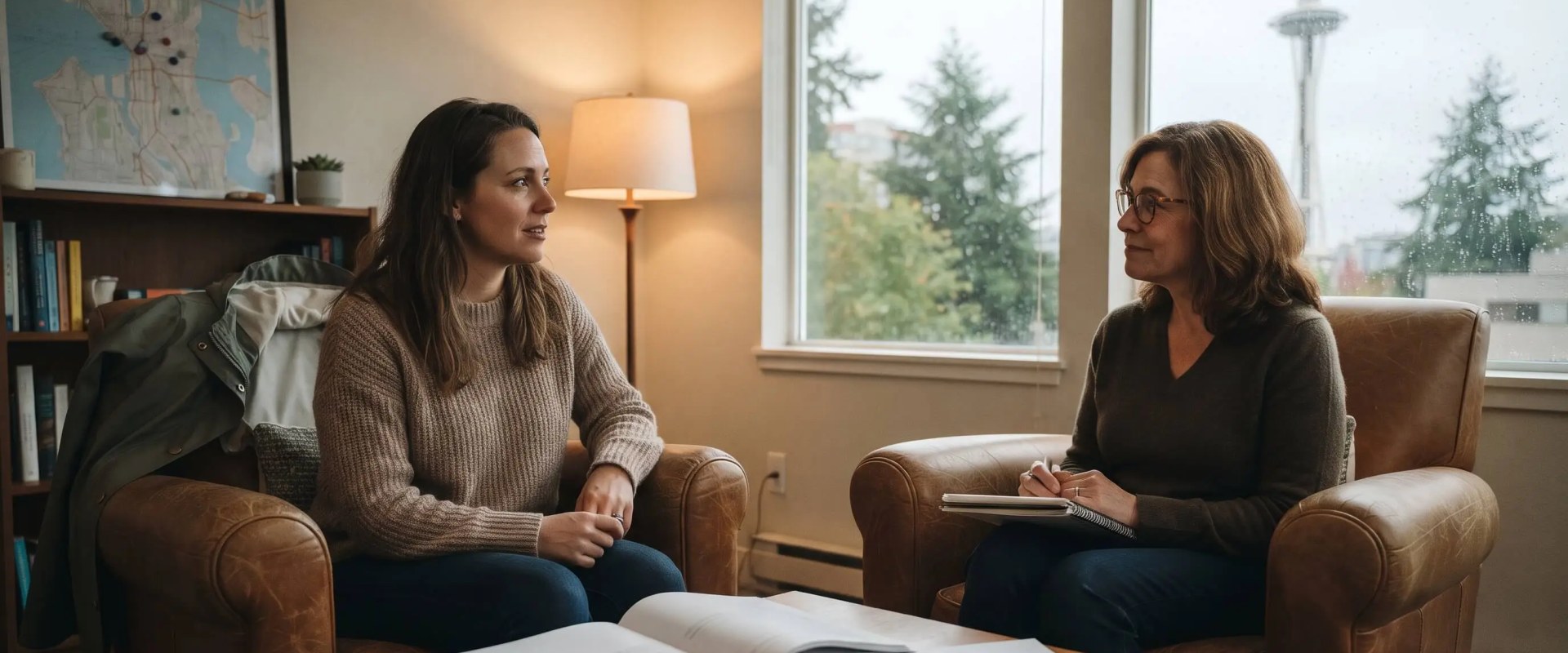
If that pattern goes back years instead of one bad night, it may be what clinicians call complex PTSD, and yes, you can find an IFS therapist in Seattle who treats it. You can also see one by secure video from anywhere in Washington. The harder work is vetting, because plenty of profiles list IFS and far fewer can tell you what training stands behind the acronym.
You probably already stay ahead of your physical health with a yearly blood panel and the occasional pressure check. Complex trauma never shows up on a lab report, which makes it easy to put off. Here's how to check who you're trusting with it when seeking IFS therapy.
TL;DR Quick Answers
IFS Therapist Seattle
Any therapist licensed in Washington and trained in Internal Family Systems can work with you in Seattle, either in person or by secure video from anywhere in the state. For complex trauma, the license and the training matter far more than how close the office is.
Check the license: confirm an LMHC, LICSW, LMFT or psychologist license through the Washington Department of Health credential search.
Ask about training level: find out which IFS Institute level they've completed, not just whether they "use IFS."
Look for trauma experience: direct work with complex or developmental trauma, and a pace that never rushes you.
Start small: book a free 15-minute consult, like the one Lauren Rath, MA, LMHC, offers for online IFS therapy anywhere in Washington.
Top Takeaways
Complex PTSD affects how you handle emotions, see yourself and stay close to people, so it calls for a therapist who's comfortable working slowly.
IFS treats guarded or reactive parts as protectors to understand, not symptoms to push past.
Check the Washington license first. Then ask which IFS training level the therapist has actually completed.
Experience with long-term or developmental trauma matters as much as the IFS credential.
Seattle residents can work with any Washington-licensed IFS therapist by video, wherever that therapist's office happens to be.
What Complex PTSD Is and Why It Calls for a Different Kind of Therapist
Complex PTSD rarely comes from one event. It usually grows out of harm that went on for years, often from people who were supposed to keep you safe, at an age when leaving wasn't possible.
The World Health Organization lists it as its own diagnosis in the ICD-11. The National Center for PTSD describes it as the core symptoms of PTSD plus lasting trouble steadying your emotions, seeing yourself clearly and staying close to people. Most U.S. clinicians diagnose with the DSM-5-TR, which folds these patterns into PTSD, so you may hear either term.
That history shapes what you need from a therapist. A system that spent years staying guarded won't open up on someone else's timeline. Methods built around a single memory can feel like being pushed. Look for someone who works with that protection rather than around it.
How IFS Works With Complex Trauma
Richard Schwartz built Internal Family Systems around something people say all the time: part of me wants to call, and another part won't let me. IFS takes that literally. Some parts protect, some carry old pain, and underneath them sits what IFS calls Self, a calm, curious center that trauma covers up without destroying.
With complex trauma, that framing changes the work. An IFS therapist treats the part that shuts down or keeps people at a distance as a protector that took the job early and never got relieved. IFS calls this "no bad parts." Men who grew up hearing they needed to toughen up often find it a relief to learn the toughness had a job, and did it well.
EMDR, another common trauma therapy, works on specific memories. IFS works on your relationship with the parts guarding them and waits for those parts to agree before going further. Trauma-focused CBT also has solid research behind it. Research on IFS for PTSD looks encouraging but is still young, mostly small pilot studies so far, and a good therapist will tell you so without being asked.
What Qualifications to Look For in an IFS Therapist in Seattle
Start With a Washington License
Check the license before anything else. In Washington you'll usually see LMHC for a licensed mental health counselor, LICSW for a licensed independent clinical social worker, LMFT for a marriage and family therapist, or a licensed psychologist. The Department of Health's provider credential search confirms the license and shows any disciplinary history. It takes about two minutes.
Ask About Training Level, Not Just the Acronym
"IFS-informed" might mean a weekend workshop or years of supervised practice. The IFS Institute trains clinicians in stages, and its practitioner directory lets you filter by level.
Level 1: the institute's foundational, in-depth training in the model
Level 2: advanced training that applies IFS to specific issues and populations
Level 3: the most advanced training level the institute offers
IFS Certified Therapist: training plus required consultation and clinical practice hours
Approved Clinical Consultant: a certified therapist approved to consult with other IFS clinicians
Therapists fill in their own directory listings, so ask directly. Someone with the training will name a level without hesitating.
Look for Experience With Complex Trauma Specifically
An IFS credential doesn't guarantee trauma experience. Ask how much of their caseload involves long-term or relational trauma, and what they do when a client goes numb or shuts down in the middle of a session.
Notice the Pace They Describe
Good complex trauma work moves slowly on purpose, because protective parts have to trust the process before anything underneath them opens up. If someone promises fast results or quotes a session count before you've met, keep looking.
Pay Attention to Cultural Fit
You shouldn't have to explain how race or masculinity shape your life before the work can start. Ask the therapist how they think about it. Their comfort answering will tell you almost as much as the answer.
Lauren Rath's page for her work as an IFS therapist in Seattle shows what that transparency looks like. She lists her Washington LMHC license and her IFS Level 1 training, says plainly that she works with trauma and CPTSD, and explains that she sees clients anywhere in the state by secure video. Expect that much clarity from anyone you're considering.
Why Many Black Men Put Off Trauma Therapy, and How to Make Starting Easier
The treatment gap shows up plainly in the numbers further down this page, and the reasons behind it won't surprise anyone. Plenty of families still read asking for help as weakness, even when it comes to routine wellness screenings. Medical systems have a long record of mistreating Black patients, so the mistrust is earned, and a clinic's polished website doesn't erase it. On top of that, few providers understand a Black man's life without needing it explained.
None of that is a personal failing. A few things can make the first step smaller:
Start with a free consultation, which commits you to nothing
Take sessions by video so you're in your own space from the first minute
Tell the therapist upfront what's off the table for now. A good IFS therapist will treat that boundary as a protector and respect it.
Look past general directories. Therapy for Black Men lists therapists and coaches who work with men of color.
Seeing an IFS Therapist From Anywhere in Seattle by Telehealth
Whether you live in Ballard, Rainier Valley or across the lake in Bellevue, the rule is the same. A therapist licensed in Washington can see you by secure video as long as you're in the state during the session, which puts every IFS clinician in Washington within reach instead of the handful with offices nearby.
Before the first session, skim the federal guidance on preparing for a telehealth visit. It covers equipment, payment and what the appointment will feel like. Find a room where nobody can overhear you, too, and give yourself ten minutes afterward before you jump back into email. Sessions can stir things up.
Questions to Ask in a Free Consultation
What IFS training level have you finished, and do you get ongoing IFS consultation?
How much of your caseload is complex or developmental trauma?
What do you do when a client starts to feel overwhelmed in session?
How will we know if we're going too fast?
Are you in-network with my insurance?
What would the first month look like?
"Going slowly is the method itself, not a preference I happen to have. Anyone promising you speed is selling you something."
Essential Resources
Telehealth. HHS.gov: For Patients. The federal guide to virtual care. Read it once before your first video session and you'll know what equipment you need and how billing usually works.
IFS Institute Practitioner Directory. The official directory of IFS-trained clinicians, searchable by city and filterable by training level and certification.
Washington State Department of Health Provider Credential Search. Confirms whether a therapist's Washington license is active and whether the state has any disciplinary action on file.
National Center for PTSD: Complex PTSD. A clear explanation of how clinicians define complex PTSD and where it differs from PTSD.
Therapy for Black Men. A directory built for men of color, with therapists and coaches you can search by location and specialty.
Frontiers in Psychiatry: Online Group IFS for PTSD and Substance Use (2025). A pilot study of an IFS program delivered entirely online. Worth a look if you're wondering whether this kind of work holds up over video.
988 Suicide & Crisis Lifeline. Free, confidential support by call or text, any hour, for you or someone you're worried about.
Finding qualified healthcare professionals for IFS therapy in Washington involves verifying therapist credentials, understanding complex PTSD, and exploring culturally responsive mental health care. Trusted resources from the IFS Institute, Washington State Department of Health, and National Center for PTSD help individuals evaluate treatment options, prepare for online sessions, and access reliable mental health support.
Supporting Statistics
14.7% versus 22.9%. In 2024, 14.7% of Black adults received mental health treatment, compared with 22.9% of all U.S. adults. Put another way, Black adults were 36% less likely to get care that year. The need is there. What lags is access and trust. Source: HHS Office of Minority Health
92% no longer met PTSD criteria. In a pilot study of adults with chronic PTSD and histories of multiple childhood traumas, 92% no longer met diagnostic criteria for PTSD after 16 weeks of IFS therapy. The study had 17 participants and no control group, so read it as a strong early signal rather than proof. Source: IFS Institute research summary of Hodgdon et al.
More than 12,000 trained clinicians. By 2022, more than 12,000 clinicians had trained in IFS, and the number keeps climbing. More options is good news, and it makes vetting matter more. Source: Ally et al., 2025, via PubMed Central
Final Thoughts
When I compared Seattle IFS listings for this piece, the profiles that stood out weren't the ones with the longest list of methods. They said plainly what the therapist was licensed as, which IFS training they'd actually finished, and how they work when trauma runs deep. Far fewer did that than you'd expect.
My view is simple. If you're carrying complex trauma, the closest therapist isn't automatically the right one. The right one holds a Washington license, has IFS training beyond a weekend, has sat with CPTSD before, and is willing to go slowly. If that person works from the other side of the state over video, most people will find that a fair trade.
And if you've been putting this off, think about it the way you'd think about any other checkup. You don't skip the physical because nothing hurts yet. Getting help early isn't a weakness. It's maintenance.
Frequently Asked Questions
Is IFS Therapy Effective for Complex PTSD?
The early research is encouraging. In one pilot study, 92% of adults with chronic PTSD and childhood trauma no longer met PTSD criteria after 16 weeks of IFS, and their depression and emotional regulation improved too. The studies so far are small, though, and larger trials are still underway. Promising is the honest word for it.
How Do I Know If an IFS Therapist in Seattle Is Properly Trained?
Ask which IFS Institute training level they've completed and whether they get ongoing IFS consultation. Cross-check the IFS Institute directory, keeping in mind that therapists fill in their own listings. Then confirm their Washington license through the Department of Health's credential search. Someone with solid training will give you a specific answer without hesitating.
What's the Difference Between IFS and EMDR for Trauma?
EMDR focuses on processing specific traumatic memories, often with eye movements or other back-and-forth stimulation. IFS focuses on your relationship with the protective parts that guard those memories, and it waits for those parts to agree before going deeper. Some therapists use both. Fit and pacing matter more than which method wins on paper.
Can I Do IFS Therapy Online If I Live in Seattle?
Yes. Any therapist licensed in Washington can treat you by secure video while you're in the state, wherever their office is. So Seattle residents can work with IFS therapists in Spokane, Tacoma or anywhere else in Washington. You'll need a private space and a decent connection.
Does Insurance Cover IFS Therapy in Washington?
Often, yes. Insurance usually covers psychotherapy with a licensed provider, and IFS is a way of doing psychotherapy rather than a separate service. Your coverage depends on your plan and whether the therapist is in-network, so ask during the consultation and confirm with your insurer before the first session.
How Long Does IFS Therapy for Complex PTSD Usually Take?
There's no fixed timeline. Complex trauma tends to take longer than single-incident trauma because protective parts have to build trust first. Some people notice shifts within a few months, and deeper work often runs longer. Be wary of anyone who guarantees a number of sessions before they've met you.
What If I'm Not Ready to Talk About What Happened?
That's a normal place to start, and IFS is built for it. You don't have to retell your story to begin. Early sessions usually focus on getting to know the parts that hesitate, and a good IFS therapist treats that hesitation as useful information. Saying "I'm not ready" in a consult is a perfectly good opening line.
Start With Fifteen Minutes
You don't have to decide anything today. If you're in Washington and want to know whether IFS fits what you're carrying, Lauren Rath, MA, LMHC, offers a free 15-minute consultation for online IFS therapy anywhere in the state. Bring your questions, get a feel for how she works, and leave it there if it isn't right.
Free, fifteen minutes, no pressure.
Book a Free Consult With an IFS Therapist in Seattle
This article is for educational purposes and isn't a substitute for professional care. If you're in immediate danger or thinking about harming yourself, call or text 988, or call 911.


